
My Learnings from “Good Services” by Lou Downe
Neha Arsid
April 27, 2026 · 9 min read
In this article, I will be sharing the valuable insights and principles I’ve gained from the book “Good Services” authored by Lou Downe. The book offers a comprehensive guide to designing services that are user-centric, efficient, and effective. These principles are not only essential for creating services that meet user needs but also for building organizations that thrive in the modern digital landscape. Let’s delve into these insights and explore how they can shape the way we approach service design and delivery. Every day, all over the world, people go online to accomplish things. They are signing up for stuff. They are checking their finances. They’re getting tickets to events, making medical appointments, applying for schools and colleges, applying for loans, and trying to see if they can afford it. For most of the part, no one wants to be doing these things. They are not exciting. They are tools for existence. We want to get through them as quickly as possible so that we can get back to doing the stuff we actually want to do. Sadly, sometimes these experiences are frustrating. There is a need to design these experiences for people to make their lives easy and delightful. Service design is a team sport. A definition of good service with common principles gives you and everyone a common focus and a goal. Today, 95% of service design projects are about fixing the basics. A service is something that helps someone to do something. Services can be thought of in conjunction with products. With service being the thing existing around the product. How we access these things is affected by the technology we use at the time. Opening a bank account in the 1900s by written correspondence is very different than it is now when the same function is accomplished through an app. The internet has changed the way we access and use services and our expectations around doing so, even if the service is not actually used online. The major challenge this creates is that your users will start by looking for what they think they need, not what you’ve decided they need. If what they find does not match what they need, they get frustrated or look for online help. Once online customer service comes into the picture, revenue will go down and the cost of service will go up.
Timeline of Services 1800s: Letters 1920s: Forms + Support 1970s: Process + Forms + Support 1980s: Process + Forms + Customer Service
** Good Services are Designed** Good Services are good for the user of the service. It does what they need it to do in a way that works for them. Good Services are good for organizations, making it profitable and easy. We have collective blindness for services. They are the gaps between things, and we not only fail to see them, but we also fail to recognize them as not working.
The 15 Principles
1. A good service is easy to Find:
The service must be able to be found by the user with no prior knowledge of the task they set out to do. For example, if someone wants to learn to drive should be able to find a way to get a driver's license as part of the service unaided. Good Services are Verbs. Bad Services are Nouns. Nouns are for experts, and Verbs are for Everyone. Avoid technical language. Describe a task, not technology while naming a service.
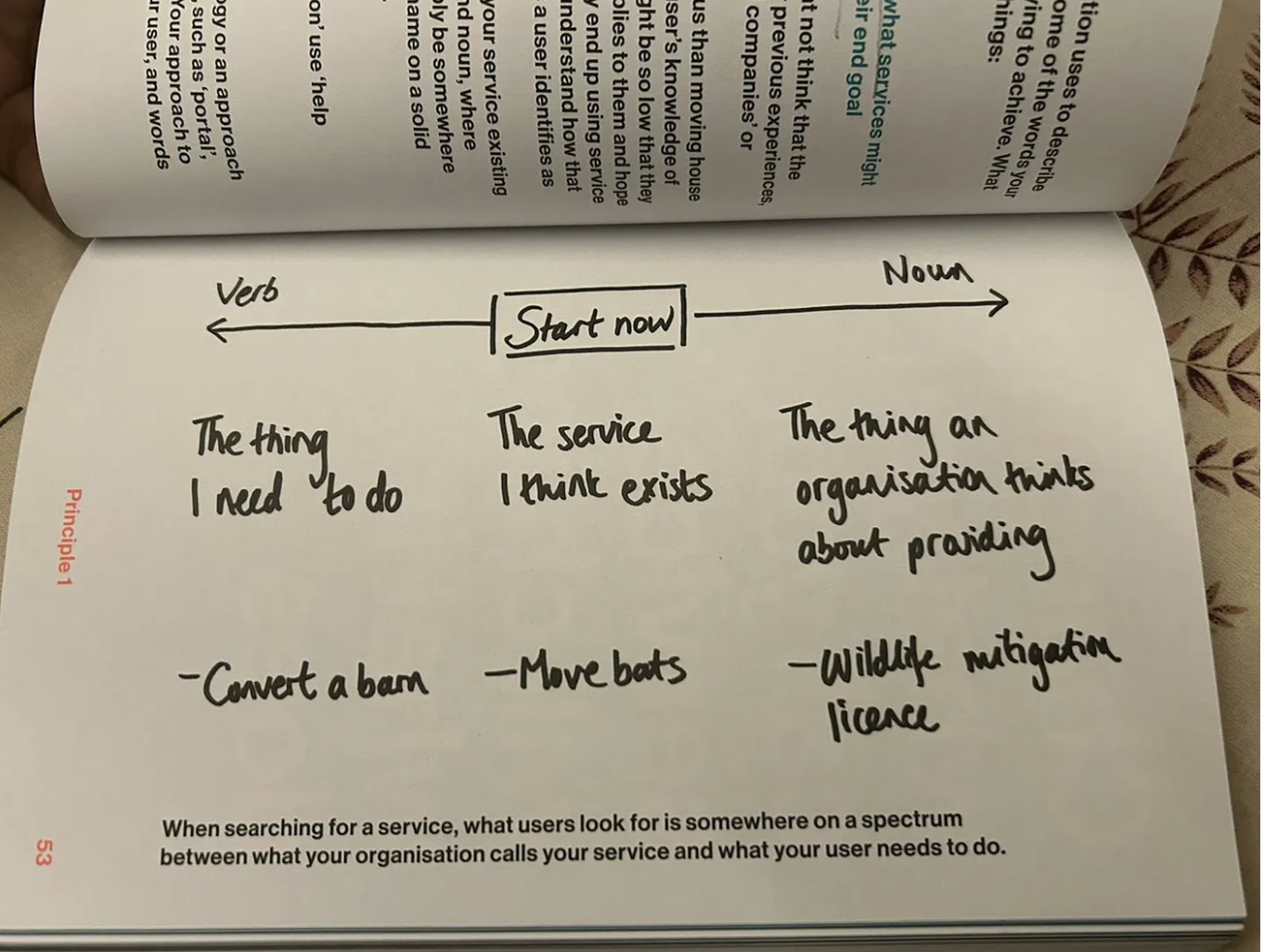
2. A good Service clearly explains the purpose:
One of the easiest mistakes people make when they are telling a story is to forget the beginning. The same goes for services. Sometimes, we think of a service as so familiar and ubiquitous that we forget to explain the most essential part of the service What the service does.
Purpose of your service: a. What your service does? b. Why it does it? c. How it does it? d. Who it’s for?
A service form follows a service function. A good service sets the expectations a user has of it.
Types of Expectations: a. Universal Expectations: These expectations are from services that are fundamental, like withdrawing money from an ATM. b. Assumed Expectations: These expectations arise when people don’t know about the service and don’t know what to expect. If a service is infrequently used or used by very few people, these expectations arise. c. Outlier Expectations: These expectations rise based on previous experience while using a similar service somewhere else. For example, if some bank provides instant notifications, users might expect these from other banks as well. With time and adoption, these outlier expectations become universal expectations.
3. A good service enables the user to complete the outcome they set out to do:
As our lives become ever more complex webs of technology and services, integration of all the parts needed to achieve a goal into one seamless service is increasingly important to the users. Design whole services from end to end, from when the user starts trying to achieve a goal to when they finish, from front to back in every channel.
4. A good service works in a way that is familiar:
Make things open; it makes things better.
5. A good service requires no prior knowledge to use:
There is no service used just by people who used it before. Services need to be designed for everyone and should be easy to understand and use.
When designing a service for someone who has no prior knowledge about it, think about: How does someone know about your service when they need it? How do they find it once they know it’s there? How do they access and use it?
6. A good service is agnostic to organizational structures:
There are 4 fundamental ways our services are designed that cause siloed and fragmented journeys to the user: Separation of Data: When Data is not shared across the organizations within a service, it leads to the collection of the same data multiple times. Incompatible processes: Process and policies of one organization don’t match with another. Incompatible criteria of use: Each part of the service has a different set of rules, making it difficult for the user to use. Usage of Inconsistent language. These 4 ways were first identified by Melvin Conway. Siloed organizations provide siloed services.
7. Collaboration is the new target operating model:
Collaboration is not very easy. People in different parts of the organization work at different paces, have different objectives, and sometimes even different financial incentives, which means that they are often at odds with each other. There are 4 things to do to support better collaboration and communication: Permission: Creating a permissive environment to work with each other. Shared Standards: Standardize service across the organization. Shared Goals: Create a common vision and purpose. Shared Incentives: Create profit-sharing agreements for the work they do. This will allow stronger communication as money will not be a concern anymore.
8. A good service requires as few services as possible:
Don’t just design the steps of your service; design the space between them. If used correctly, these transitional moments aren’t just empty spaces but spaces with a purpose to give users visibility and control of decisions they need to make to move forward in a goal. Japanese dry landscape gardens capture these ideas perfectly, often called Zen gardens. They have few items placed at large distances and are built on the principle of ‘yohaku no bi’ or the beauty of white space. Services are made of small parts, but they are more than the sum of their parts. How many steps the user has and how quickly the user can complete all the steps are very important.
9. A good service is consistent throughout
The service should look like one service throughout regardless of the channel it’s delivered through. The language used should be consistent, as should visual styles and interaction patterns. Minimum viable service: It’s not always possible to develop the entire service all at once. So a minimum viable service can be created aiming for a service where most users can navigate and accomplish the goal they set out to.
10. A good service should have no dead ends:
People have different abilities, life circumstances, and access to information at the time they use your service. Dead ends happen when we fail to predict all the reasons why someone might not be able to do what we have asked them to do within our service or where we have designed a pathway that is too narrow to accommodate even minor deviance.
There are 6 ways to mitigate dead ends: Provide onward routes for people who are not eligible to use your service. Evenly distribute the complexity of your service. Ensure your service is inclusive. Minimize the number of requirements you ask your user. Build affordances. Let your service degrade gracefully with the progress of technology.
11. A good service is usable by everyone equally:
Inclusion is a necessity, not an enhancement. Testing your service with the most extreme edge cases ensures that your service works for the most standard needs. Make sure your service is safe, perceivable, understandable, operable, robust, and equal. A lack of diversity in your team equals a lack of inclusion in your service.
12. A good service encourages the right behaviour from users and staff.
13. A good Service should respond to change quickly.
14. A good service clearly explains why a decision has been made.
15. A good service makes it easy to get human assistance.
In conclusion, the principles outlined in “Good Services” by Lou Downe serve as a roadmap for designing services that truly make a difference in people’s lives. By prioritizing user needs, fostering collaboration, and embracing inclusivity, we can create services that are not just functional, but delightful to use. In an increasingly complex and interconnected world, the value of designing good services cannot be overstated. By applying these principles, we can build services that not only meet today’s challenges but also adapt and thrive in the face of change, ensuring that the focus remains on making life easier and more enjoyable for everyone.
Got thoughts? I'd love to hear them.
Reply via email →More writing
The Designer's New Reality: How to Own Your Craft in the Age of Claude
*A practical guide for designers navigating AI-assisted design: from building your first org design system to handing off production-ready components, without...
Jun 3, 2026 · 21 min read
About design talks at Okta
Last Friday, I attended an incredibly thought-provoking event on “The UX of Trust & Security” hosted by Friends of Figma, Bangalore x Okta . I went in expectin...
May 11, 2026 · 2 min read